MCP Prompts Playbook
Last updated: October 28, 2026
Before you start
Connect GoodTime in Claude via the + button in any conversation, then Connectors, then search for GoodTime. You'll need an Admin or Super Admin role in GoodTime, and the connector only ever sees what you can already see.
Once connected, you can ask naturally. You don't need to say "use GoodTime" every time — Claude will select the connector automatically when it's relevant.
Four habits that make the difference
The gap between a vague answer and a decision-grade one usually comes down to how the question was asked. These four habits do most of the work.
1. Define your metric before you ask for it
If you don't say how a metric is calculated, you're leaving it to interpretation, and the answer will look confident either way. Spell out the arithmetic the first time you use a term and Claude will hold that definition for the rest of the conversation.
Instead of asking "what's our time to fill?", ask:
Time to fill means the number of days from the application date to the date the offer was accepted. Using that definition, what's our median time to fill for active Engineering roles this quarter?
2. Always ask to see the underlying records
A number on its own is a claim. A number with the rows behind it is evidence you can take into a meeting. Make this a reflex on anything you plan to share.
Now show me the full list of interviews that went into that average, with the candidate, the job, the interviewer, and the date for each.
3. Anchor every number to a comparison
A metric with no baseline isn't actionable. Anchor to the previous period, the same period last year, another team, or the GoodTime industry benchmark. Otherwise you can't tell whether 14 days is good or alarming.
Compare that to the same quarter last year and to the GoodTime benchmark, and tell me whether the change is large enough to be meaningful or likely just noise.
4. Keep the thread going
The first answer is rarely the insight. The insight is in the third or fourth follow-up. Every playbook below is built as a chain for exactly this reason — the starter prompt opens the door, the follow-ups find the thing.
That's surprising. Break that same figure down by department, then show me which three jobs are pulling the average up the most.
Playbook 01: My coordinators are drowning and I need to prove it
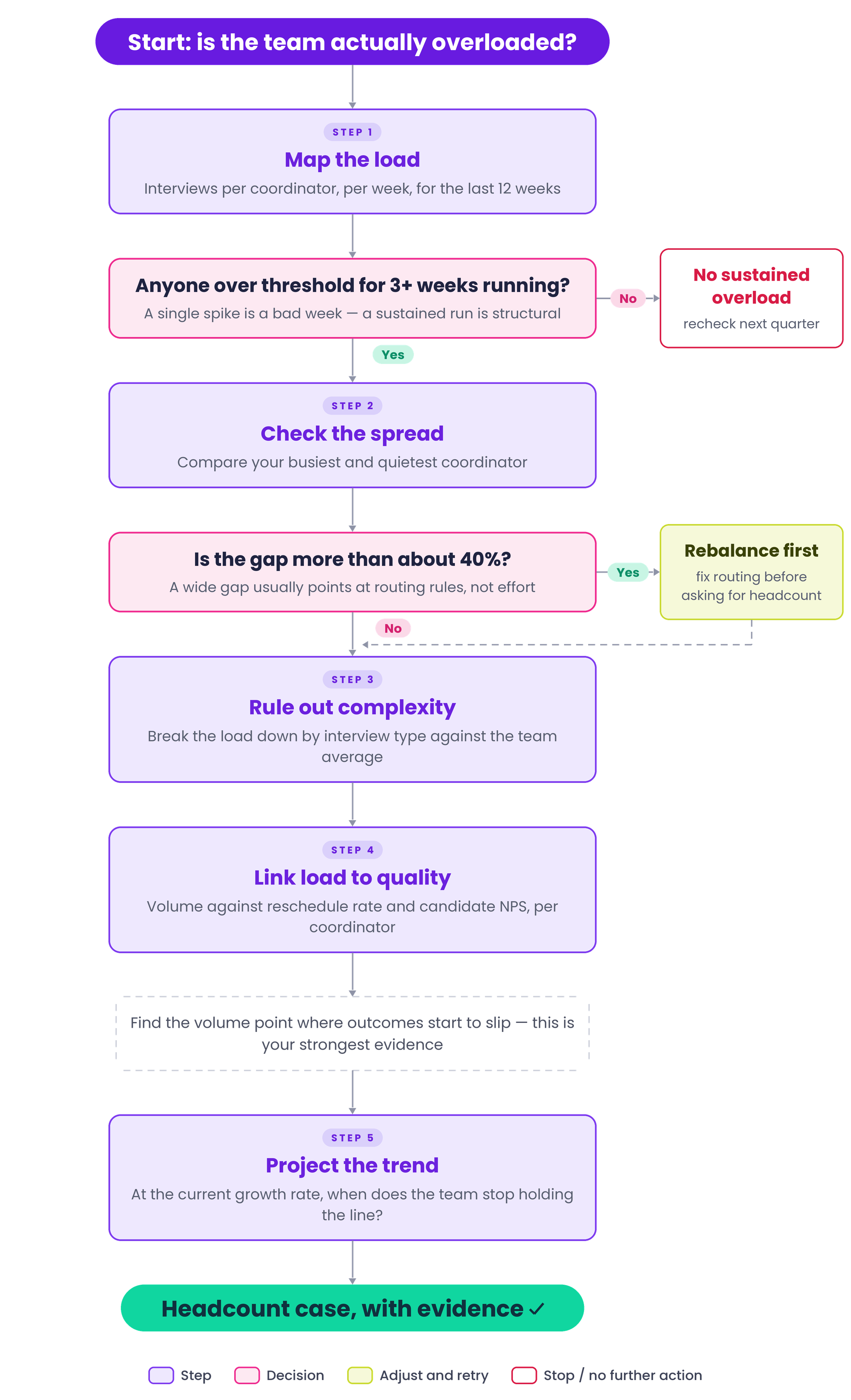
You can feel the strain across the team, but "everyone's busy" doesn't get you headcount. What gets you headcount is showing a sustained, uneven load with a date on it, and showing that you already tried rebalancing first. Standard reports show totals. This shows distribution over time, which is the part that makes the case.
Start here
Show me the total number of interviews scheduled per coordinator, per week, for the last 12 weeks. Present it as a table with coordinators as rows and weeks as columns so I can see the trend across the whole team.
Then go deeper
We try to keep each coordinator at or below 100 interviews per week. Flag every coordinator who has been over that threshold for three or more consecutive weeks, and tell me how many weeks over they've been in total.text
Now show me the opposite — which coordinators are consistently under 60 interviews per week? Compare the busiest and least busy coordinator side by side and tell me how big the gap is as a percentage.
Is the overloaded coordinator carrying more interviews, or more complex ones? Break their workload down by interview type — panel, batch, single — and compare that mix to the team average.
Does workload correlate with quality? For each coordinator, show their weekly interview volume next to their reschedule rate and their average candidate NPS. Is there a volume point where outcomes start to slip?
Based on our current volume trend over the last quarter, if growth continues at the same rate, when would we cross the point where the existing team can't hold the line? Show me the assumption behind that estimate.
What you're looking for
Someone over the threshold for three or more consecutive weeks. A single spike is a bad week; a sustained run is a structural problem.
A gap of more than roughly 40% between your busiest and quietest coordinator, which usually points at routing rules rather than effort.
Quality metrics degrading above a certain volume. This is the single most persuasive data point you can bring to a headcount conversation.
Playbook 02: Candidates are stalling somewhere and I can't tell where
Your overall time to hire is creeping up. That number is a symptom. The cause is almost always one or two specific transitions that nobody owns. The trick is to separate the time the process takes from the time the process waits.
Start here
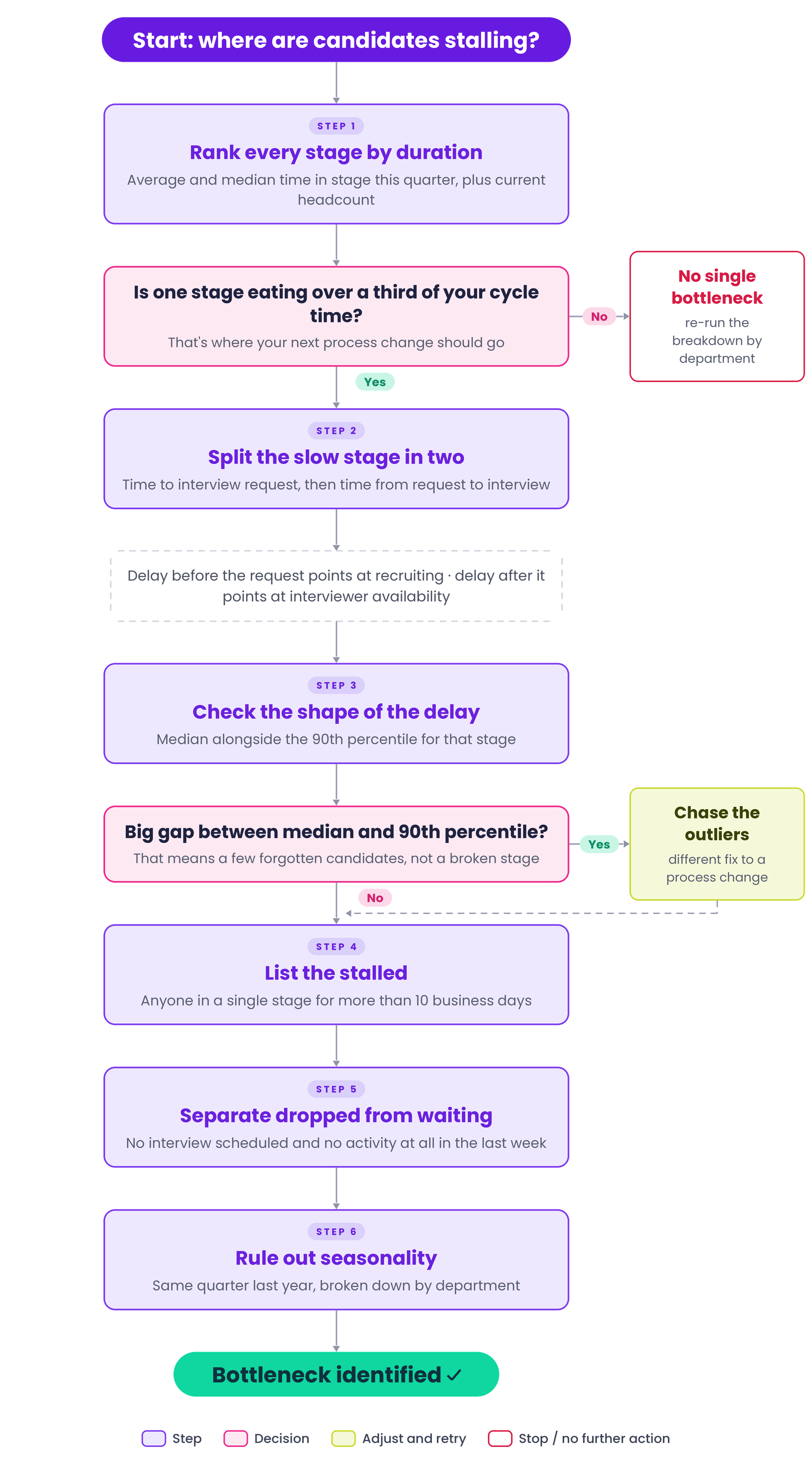
For all active jobs, show me the average and median time candidates spend in each stage this quarter. Sort from longest to shortest, and include how many candidates are in each stage right now.
Then go deeper
For the slowest stage, split the time into two parts: how long it took from entering the stage to the interview being requested, and how long from request to the interview actually happening. Which half is the real delay?
Show me the median alongside the 90th percentile for that stage. Is this a broad slowdown affecting everyone, or a small number of badly stuck candidates dragging the average?
List every active candidate who has been sitting in a single stage for more than 10 business days, with the job, the stage, the recruiter, and the date of the last recorded activity on their application.
Of those stalled candidates, which ones have had no interview scheduled and no activity at all in the last week? Those are the ones genuinely dropped rather than just waiting on a scheduled step.
Compare time in stage for this quarter against the same quarter last year, broken down by department. Where has it genuinely got worse, and where is this just our normal seasonal pattern?
What you're looking for
A large gap between median and 90th percentile means a handful of forgotten candidates, not a broken process. That's a very different fix.
Delay concentrated before the interview request points at the recruiting team. Delay after the request points at interviewer availability.
Any single stage consuming more than a third of your total target cycle time is where your next process change should go.
Playbook 03: We're rescheduling constantly and nobody knows why
Reschedules are expensive twice: once in coordinator time, and again in candidate goodwill. The totals rarely tell you anything. The breakdown by cause, by source, and by concentration almost always does. Work from volume, to cause, to concentration.
Start here
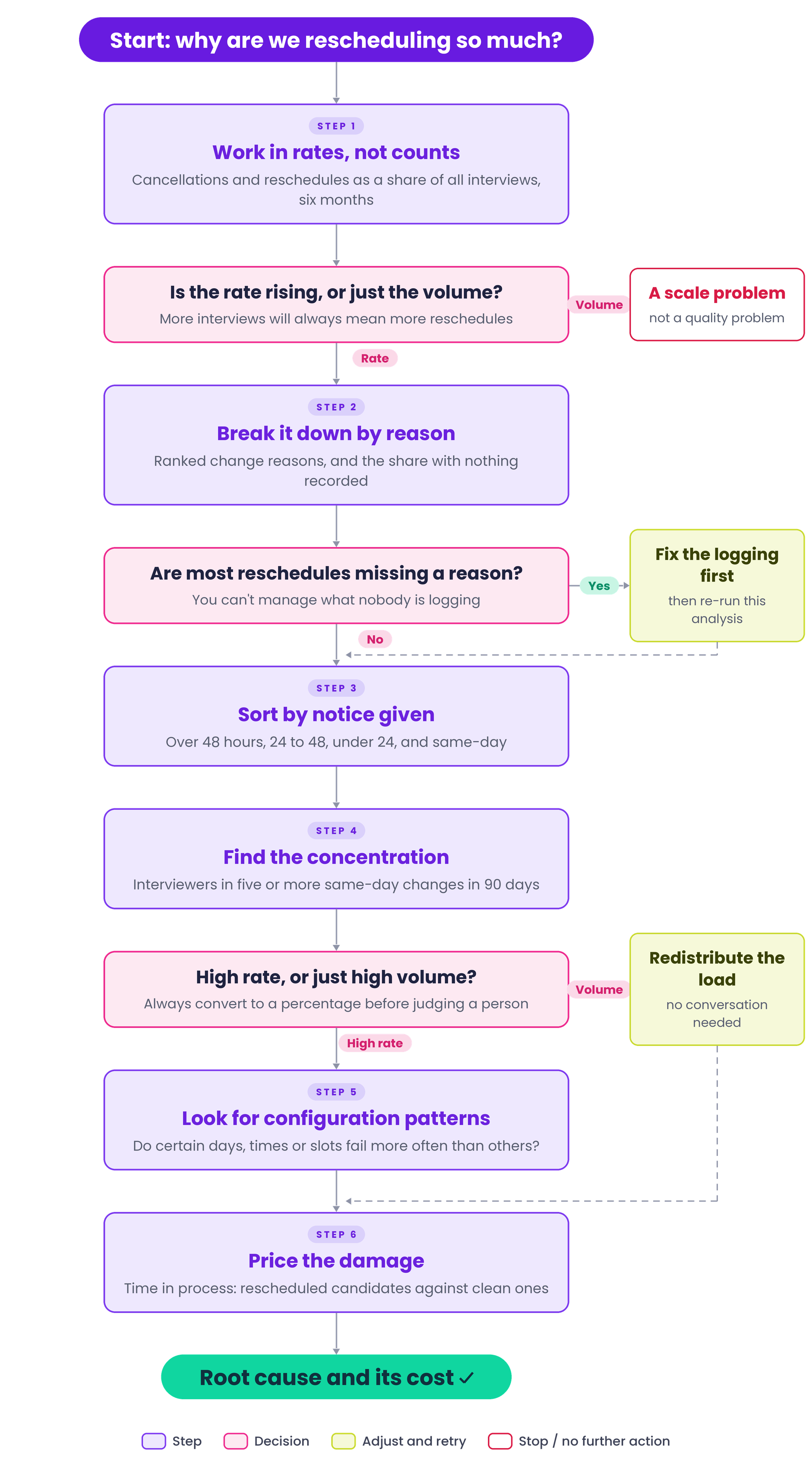
Show me total cancellations and reschedules per month for the last six months, as a count and as a percentage of all interviews scheduled that month. Is the rate going up or is it just volume?
Then go deeper
Break the last quarter's reschedules down by recorded change reason, ranked by frequency. What share of them have no reason recorded at all?
Split reschedules by how much notice was given: more than 48 hours, 24 to 48 hours, under 24 hours, and same-day. Same-day changes cost the most — what share are they, and is that share growing?
Of the same-day changes in the last 90 days, how many are concentrated in a small group of interviewers? Show me anyone involved in five or more, with their department and the dates.
For those interviewers, is their reschedule rate high in absolute terms or just because they interview far more than anyone else? Show reschedules as a percentage of their total assigned interviews.
Do reschedules cluster around particular days, times, or calendar patterns? Check whether certain interview slots fail more often than others — that would point at a scheduling rule rather than individual behaviour.
What happens to candidates whose interview is rescheduled? Compare their average total time in process against candidates whose interviews ran as planned, so I can quantify the cost.
Interpret this carefully
High reschedule counts often track with high interview volume. Always convert to a rate before drawing a conclusion about a person.
Clustering by time slot or calendar pattern usually means a configuration issue: availability rules, calendar sync, or a template set up wrong. That's a fix, not a conversation.
A high share of reschedules with no recorded reason is itself the finding. You can't manage what nobody is logging.
Playbook 04: We're about to run out of interviewer capacity
Capacity problems announce themselves late, usually as scheduling lead times quietly getting longer, weeks before anyone names the cause. The goal here is to see the ceiling before you hit it, with enough notice to train new interviewers.
Start here
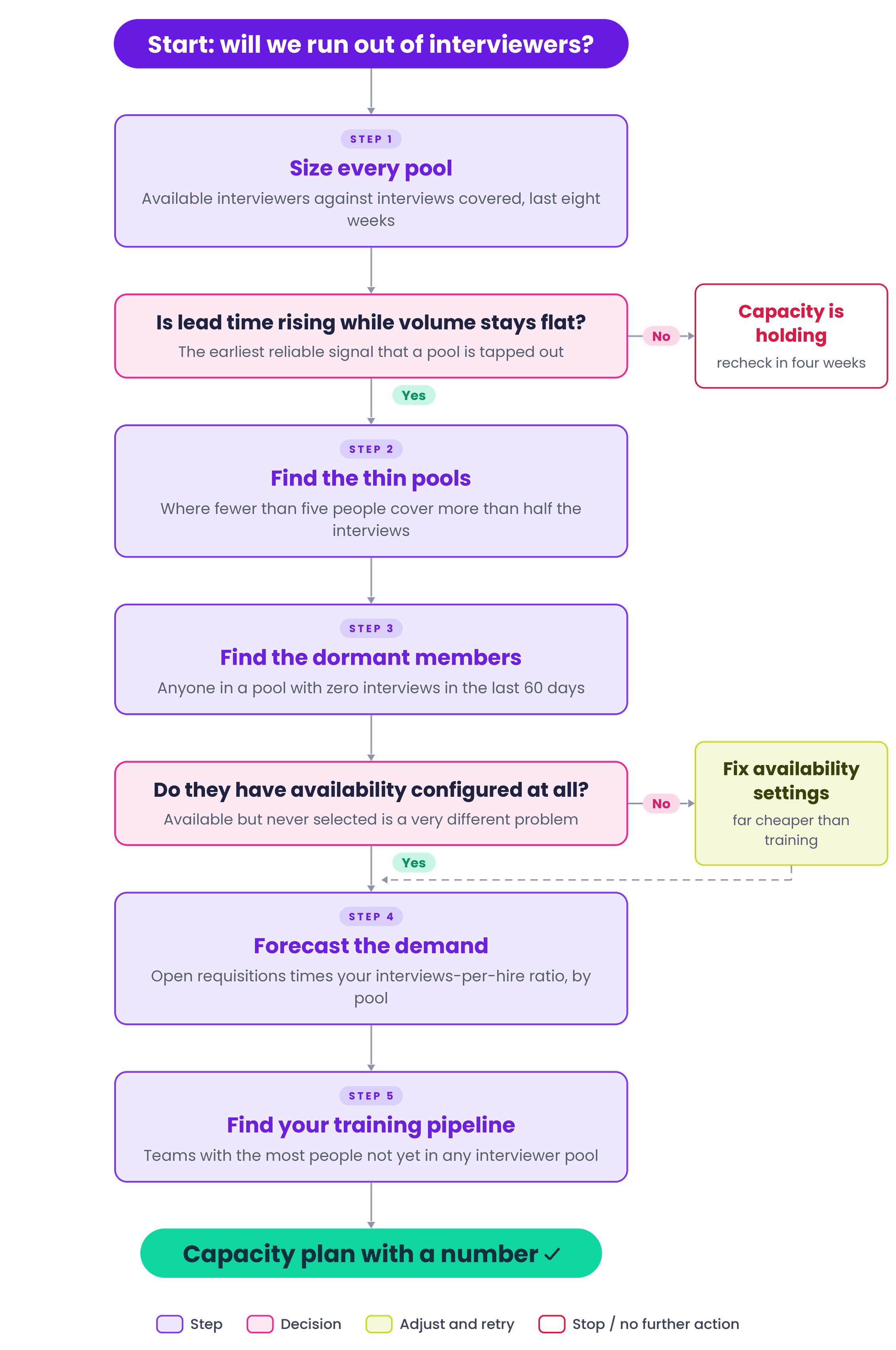
For each interviewer pool, show me how many active, available interviewers it contains and how many interviews that pool was asked to cover in each of the last eight weeks.
Then go deeper
Which pools are the thinnest? Show me every pool where fewer than five people are carrying more than half of that pool's interviews — those are our single points of failure.
Has scheduling lead time increased for any specific pool over the last eight weeks? Rising lead time against flat volume usually means we're scraping the bottom of available capacity.
Who is in our pools but effectively inactive? List anyone tagged into an interviewer pool who has conducted zero interviews in the last 60 days, grouped by pool and department.
For those inactive interviewers, is the issue availability settings or demand? Check whether they have interview availability configured at all, versus being available but never selected.
Based on the open requisitions we have right now and our typical number of interviews per hire, estimate how many interviews each pool will need to cover over the next quarter. Where does demand exceed what the pool has been able to deliver historically?
Which teams have the most people who are not yet in any interviewer pool? That's my best pool of candidates to recruit and train as new interviewers.
What you're looking for
Lead time rising while volume stays flat is the earliest reliable signal that a pool is tapped out.
Any pool where a handful of people cover the majority of interviews is one holiday away from a bottleneck.
Large numbers of configured-but-inactive interviewers usually mean an availability setup problem, which is far cheaper to fix than training new people.
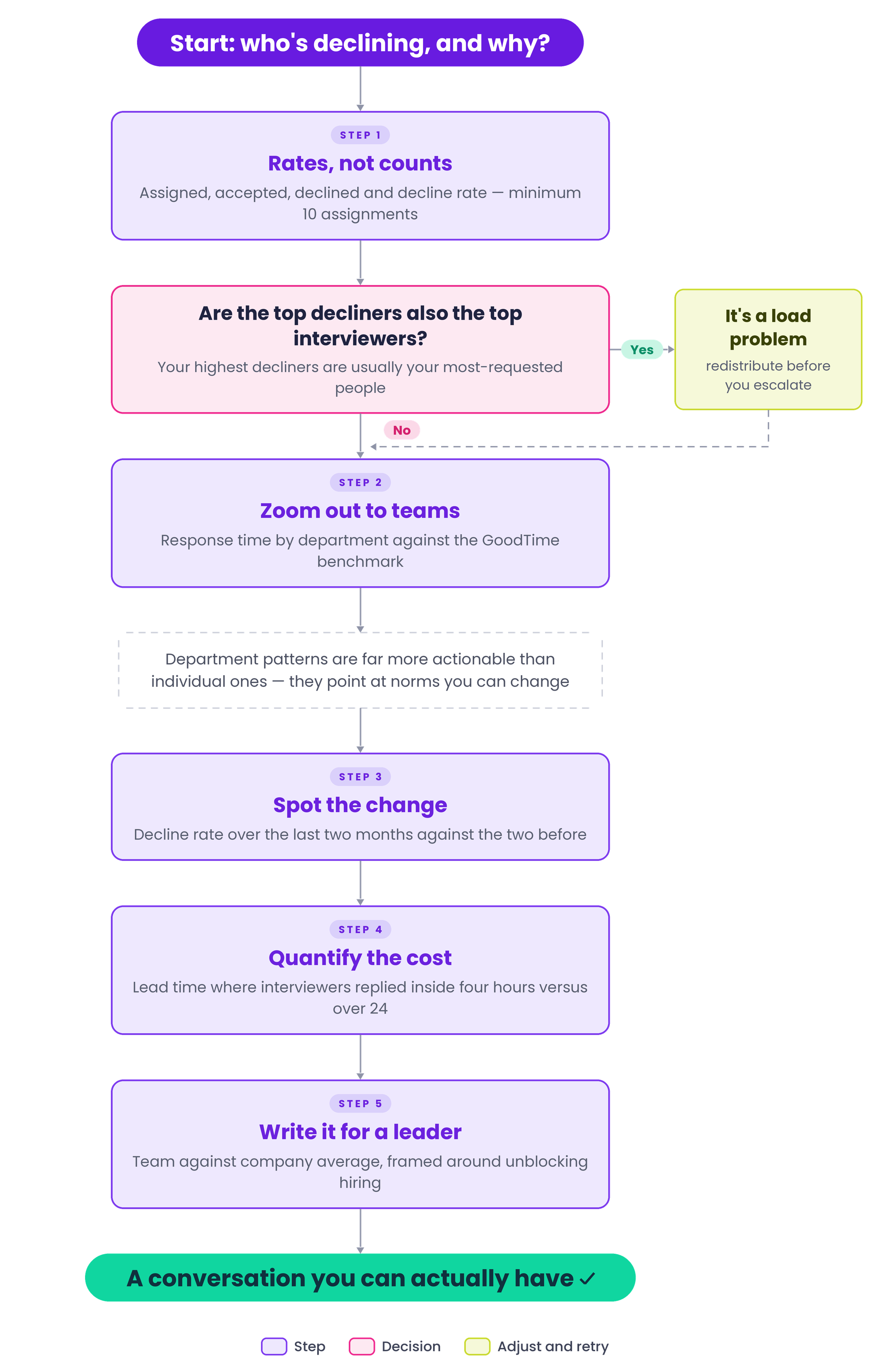
Playbook 05: The same few interviewers keep declining
Declines slow everything downstream, but the people declining most are often the people being asked most. Lead with rates, not counts, and separate "overloaded" from "disengaged" before anyone has a conversation about it.
Start here
For the last 90 days, show me every interviewer with their total assigned interviews, accepted, declined, and their decline rate as a percentage. Sort by decline rate, but only include people with at least 10 assignments.
Then go deeper
For the highest decliners, is this a capacity issue? Show their decline rate alongside their total interview load, and tell me whether the people declining most are also the people interviewing most.
Compare average interviewer response time by department. Which teams take longest to confirm or decline an assignment, and how does that compare to the GoodTime industry benchmark?
Has anyone's decline rate changed sharply in the last two months compared to the two months before? A sudden shift usually signals a role change, a workload change, or disengagement worth asking about.
What is a slow response actually costing us? Compare average scheduling lead time for interviews where the interviewer responded within four hours against those where it took more than 24 hours.
Draft a short, non-accusatory summary I could bring to an engineering leader showing their team's interviewer response times and declines compared to the company average, framed around unblocking hiring rather than individual performance.
Interpret this carefully
Your highest decliners are frequently your most-requested interviewers. The fix is usually load distribution, not a performance conversation.
Department-level patterns are far more actionable than individual ones. They point at manager expectations and team norms you can change.
A sudden change in one person's pattern is worth a kind check-in, not a flag. The data tells you where to ask, not what the answer is.
Playbook 06: Our candidate experience score dropped and I need the cause
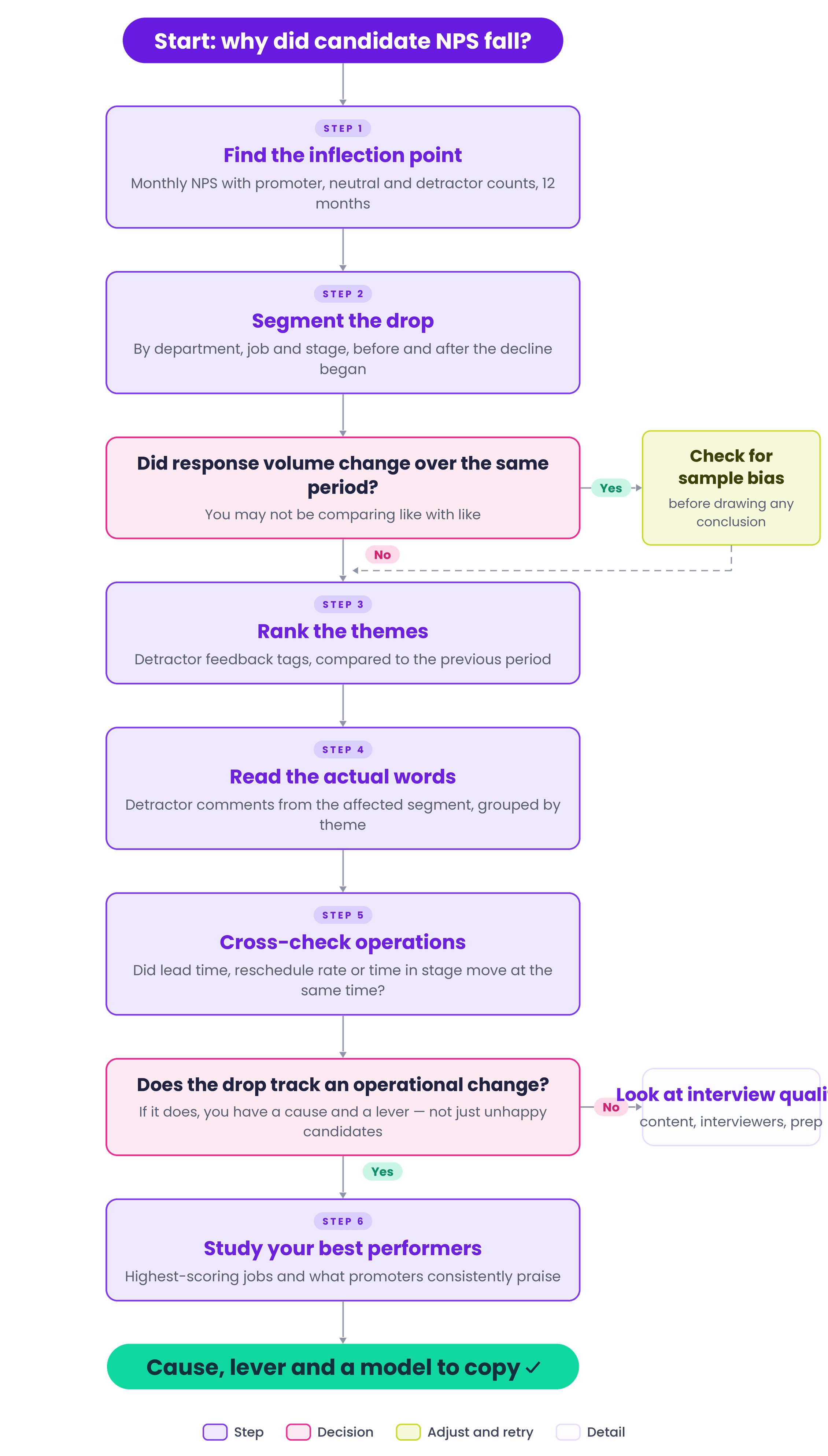
An NPS drop is a headline with no story attached. The story lives in the segment breakdown and the free-text comments. Narrow by segment first, then read what candidates actually said.
Start here
Show me our candidate NPS by month for the last 12 months, with promoter, neutral, and detractor counts for each month. When exactly did the decline start?
Then go deeper
Did the score fall across the board, or in specific places? Break NPS down by department, by job, and by interview stage for the period before and after the decline started.
Is this a real change or a shift in who's responding? Compare response volume and response rate before and after, so I know whether we're comparing like with like.
Pull the feedback tags from detractor responses in the affected segment and rank them by frequency. Which themes grew most compared to the previous period?
Show me the actual detractor comments from that segment, grouped by theme. I want to read what candidates said in their own words, not just the tags.
Cross-reference this against operations: for the affected segment, did scheduling lead time, reschedule rate, or time in stage change over the same period? I want to know whether the experience drop tracks an operational change.
Now show me the opposite: which jobs or stages have our highest scores, and what do promoters consistently praise? I want to know what we should be replicating.
The step most people skip
The cross-reference step is the one that turns a complaint into a fix. If scheduling lead time rose in the same weeks the score fell, you have a cause and a lever, not just unhappy candidates.
The final step is how you build an internal playbook. The team with the best scores is usually doing something specific and repeatable that nobody has written down.
Playbook 07: We lost a great candidate late in the process
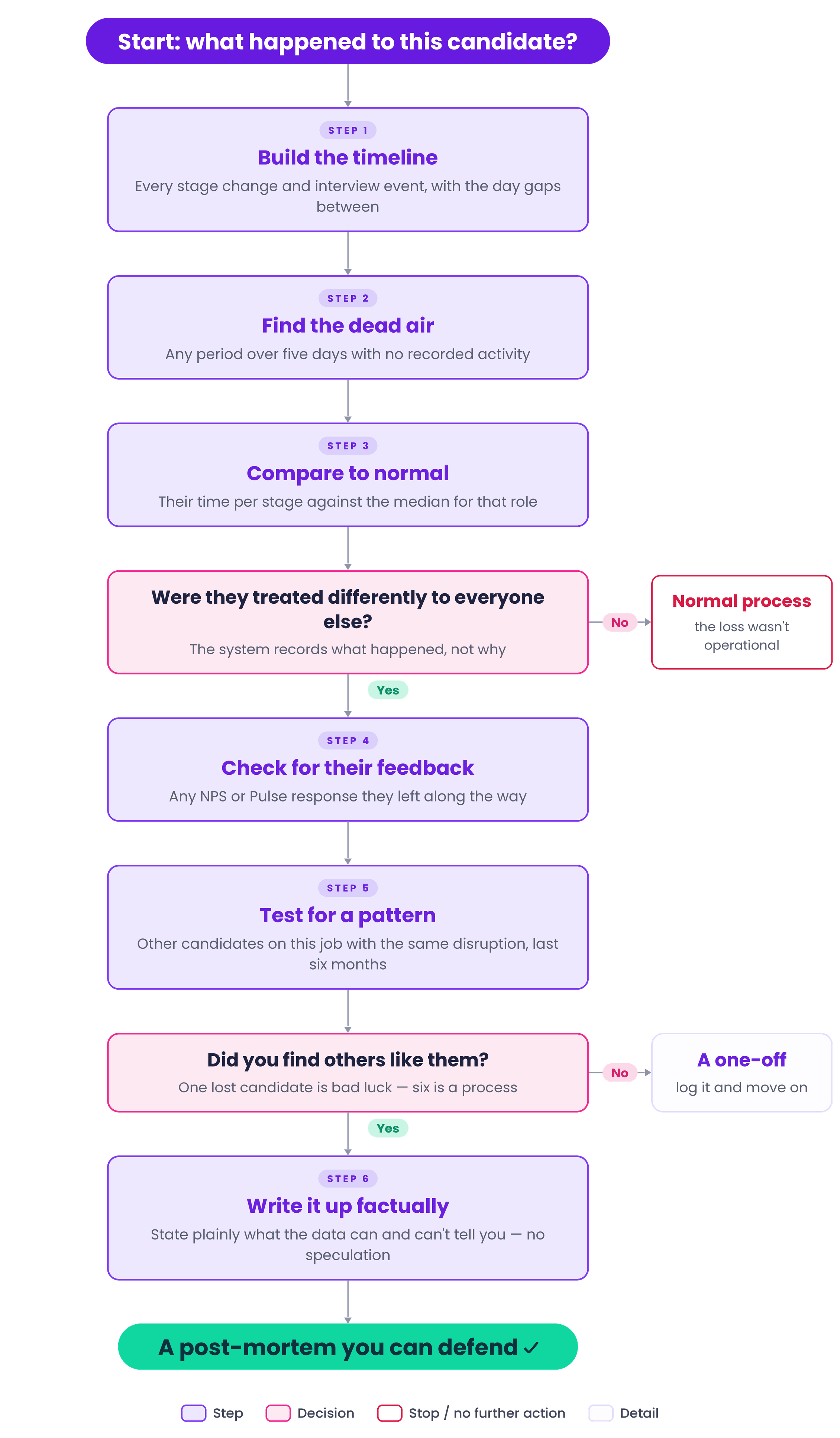
Someone senior wants to know what happened, and you need a factual timeline rather than a reconstruction from memory and Slack threads. Build the timeline first, draw conclusions second, then check whether it's a pattern.
Start here
Give me the complete chronological timeline for [candidate name]'s application: every stage change, every interview requested, scheduled, rescheduled or cancelled, who made each change, and the gap in days between each event.
Then go deeper
Where were the longest gaps in that timeline, and what was happening during each one? Highlight any period of more than five days with no recorded activity.
How did this candidate's experience compare to the typical candidate for the same job and stage? Show their time in each stage against the median for that role.
Did they leave any NPS or Pulse feedback at any point in the process? If so, show me their scores and comments.
Is this an isolated case? Find other candidates on the same job who experienced a similar delay or disruption pattern in the last six months, and tell me how many there were.
Write me a short, factual post-mortem based only on what's in the data: the timeline, where the delays were, what we can verify, and what we can't tell from the system. Keep it neutral — no speculation about intent.
Handle with care
The system records what happened, not why. A gap might be a dropped ball or a candidate on holiday, so ask the post-mortem step to say explicitly what the data can't tell you.
The pattern check is what makes this worth doing. One lost candidate is bad luck; six with the same pattern is a process you can fix.
Playbook 08: I need to show leadership what the team is actually delivering
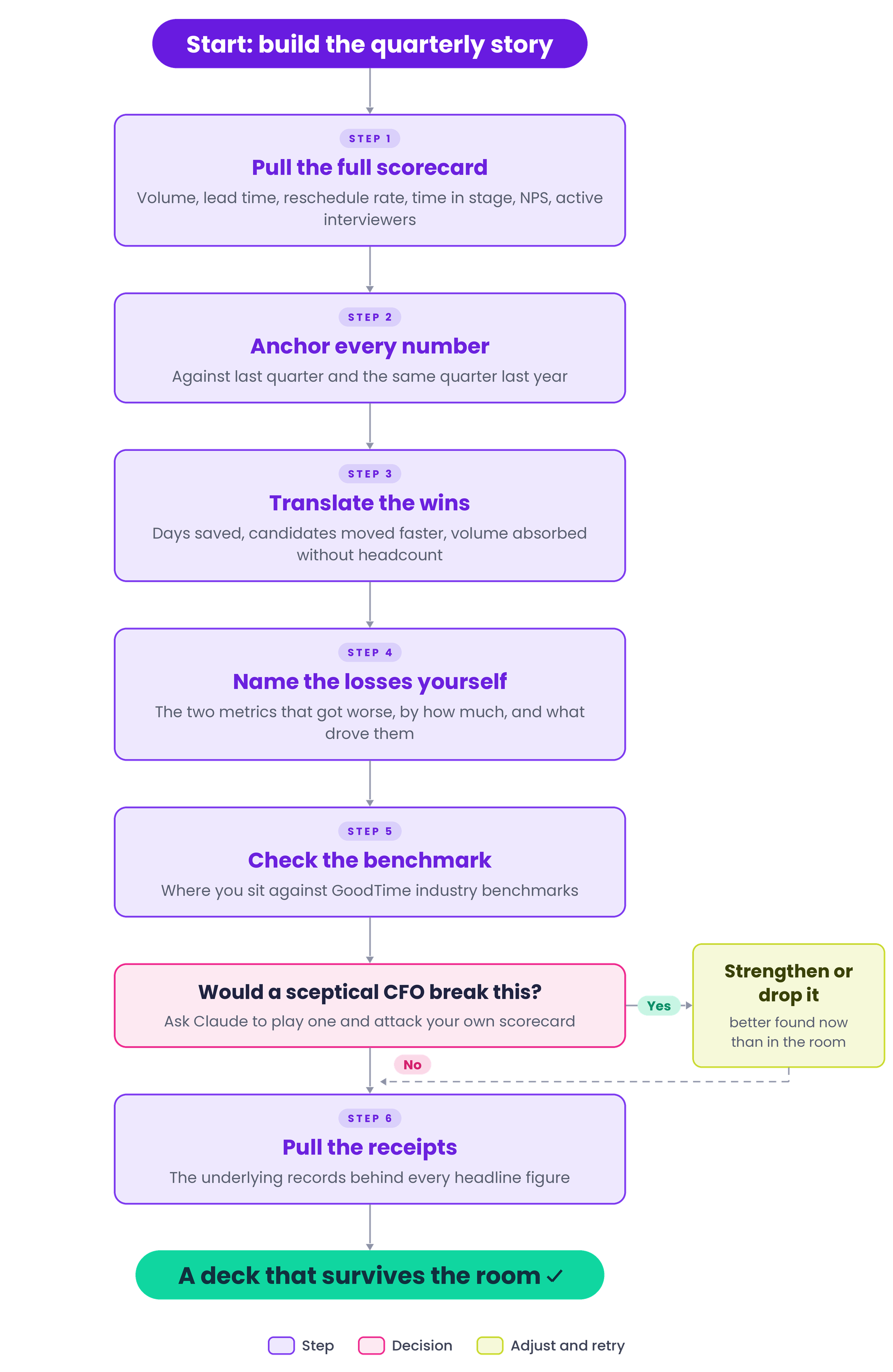
Recruiting ops work is invisible when it goes well. A quarterly review is your chance to make it visible, with numbers, comparisons, and a clear ask. Build the whole narrative in one conversation, then pressure-test it before you present.
Start here
Give me a complete quarterly scorecard: total interviews scheduled, median scheduling lead time, cancellation and reschedule rate, average time in stage, candidate NPS, and total active interviewers. Show each one against the previous quarter and the same quarter last year.
Then go deeper
Which three metrics improved most, and can you quantify the impact in terms a non-recruiting leader would care about — days saved, candidates moved faster, interviews absorbed without added headcount?
Where did we handle more volume with the same or fewer people? Show interviews per coordinator per quarter over the last six quarters — that's our efficiency story.
Now the honest half: which two metrics got worse, by how much, and what does the data suggest about why? Don't soften it — I'd rather raise it myself than have it raised for me.
How do our numbers compare to the GoodTime industry benchmarks where they're available? Flag anywhere we're meaningfully ahead or behind.
Act as a sceptical CFO reviewing this scorecard. What would you push back on, which numbers would you want the underlying data for, and where is the narrative weakest?
Pull the supporting records for every headline number so I have the receipts if anyone asks where a figure came from.
Why the CFO step matters
Having the critique before the meeting is worth more than having the deck. You'll find the weak number yourself rather than discovering it live.
Pair it with the receipts step and you walk in able to answer "where did that come from?" instantly, which is usually the moment credibility is won or lost.
Playbook 09: Our interview process is configured inconsistently
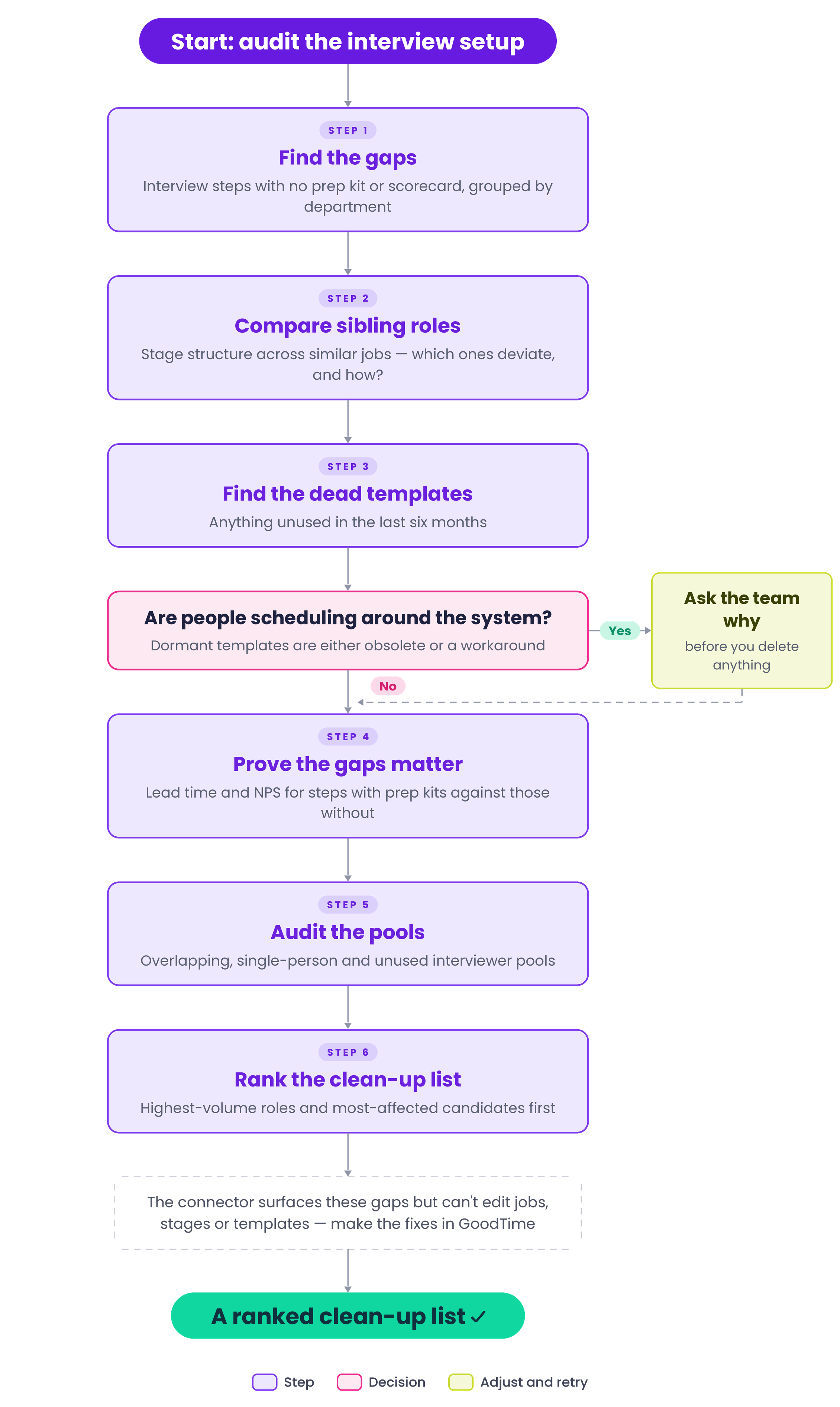
Configuration drift is slow and invisible: a prep kit missing here, a scorecard never attached there, a stage structured differently from its sibling roles. It shows up later as a bad candidate experience nobody can explain. This is the audit nobody has time to do manually.
Start here
Across all active jobs, list every interview step that has no preparation kit attached, no scorecard template, or both. Group by department so I can see where the gaps cluster.
Then go deeper
Compare the stage structure of all active Engineering jobs side by side. Which ones deviate from the most common pattern, and how?
Which interview templates are actually being used, and which haven't been used in the last six months? Dormant templates are usually either obsolete or a sign people are scheduling around the system.
Do jobs with complete configuration perform better? Compare scheduling lead time and candidate NPS for interview steps that have a prep kit against those that don't.
Show me our interviewer pool tag structure: which pools overlap heavily, which contain only one or two people, and which haven't been used to staff an interview in 90 days.
Give me a prioritised clean-up list: the configuration gaps that affect the most candidates or the highest-volume roles first, with a one-line reason for each.
A note on scope
The connector can surface every one of these gaps, but it can't create or edit jobs, stages, interview steps, or templates. Use this to build the list, then make the fixes in GoodTime.
Worth running quarterly. Configuration drifts fastest right after a hiring push, when people create roles in a hurry.
Playbook 10: I want to recognise the people quietly carrying the team
Most reporting is built to find problems. The same data finds the people who consistently show up, respond fast, and leave candidates feeling good, and those people are almost never the loudest. This is the highest-return, lowest-effort thing on this page.
Start here
Find interviewers who are in the top quartile for interview volume and have an above-average acceptance rate and a faster-than-average response time this quarter. These are the people quietly holding the process together.
Then go deeper
Which interviewers are associated with the highest candidate NPS scores, with at least 10 interviews behind the number so it's not a small-sample fluke?
Do any candidate comments mention specific interviewers positively? Pull promoter feedback that names or describes a strong interview experience.
Which coordinators have the lowest reschedule rates relative to their volume? That takes real discipline and never shows up in a standard report.
Who has stepped up the most this quarter compared to last — biggest increase in interviews accepted, or biggest improvement in response time?
Draft short, specific recognition notes I could send to each of these people's managers — one or two sentences each, with the actual numbers included.
Why this is worth your time
Interviewing is unpaid, unglamorous work that people opt into. Recognition with real numbers attached is the cheapest way to protect your interviewer pool.
A note to someone's manager carries far more weight than a thank-you to the person. It shows up at review time.
Playbook 11: Are we evaluating candidates consistently?
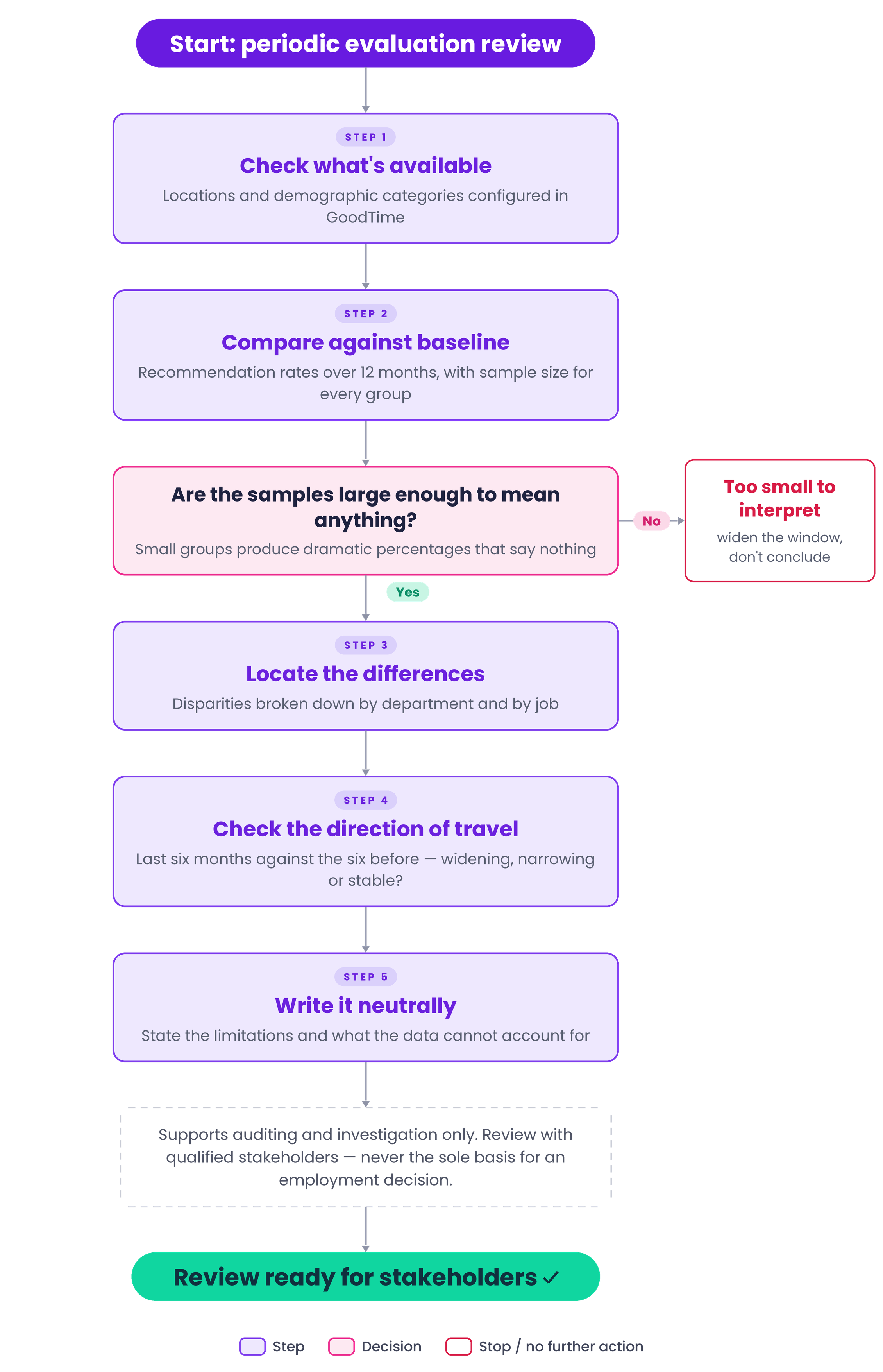
This is a question you want to be able to answer before someone else asks it. The connector surfaces evaluation outcomes across the demographic categories configured in GoodTime, so you can run a periodic review rather than waiting for an audit. Treat the output as a map of where to look, not a conclusion.
Start here
What locations and demographic categories are available for candidate-evaluation analysis in our organization?
Then go deeper
Compare candidate recommendation rates across the available categories for the last 12 months, against our established baseline. Include the sample size for each group.
Where are the differences from baseline largest, and which of those are based on samples big enough to be meaningful rather than noise?
Break the disparities down by department and by job. Is this a company-wide pattern or concentrated in particular teams or roles?
Has the pattern changed over time? Compare the last six months against the six months before to see whether it's widening, narrowing, or stable.
Write a neutral narrative summary of what the data shows, clearly stating the limitations — sample sizes, what the data can't account for, and why these findings need review by qualified stakeholders before any action is taken.
Important
These insights support auditing and investigation. They should be reviewed by qualified stakeholders and must never be the sole basis for an employment decision.
Always ask for sample sizes. Small groups produce dramatic-looking percentages that mean nothing, which is exactly what the third step exists to protect you from.
Loop in your legal and People partners before circulating anything from this playbook.
Playbook 12: I'm about to onboard a new coordinator or interviewer cohort
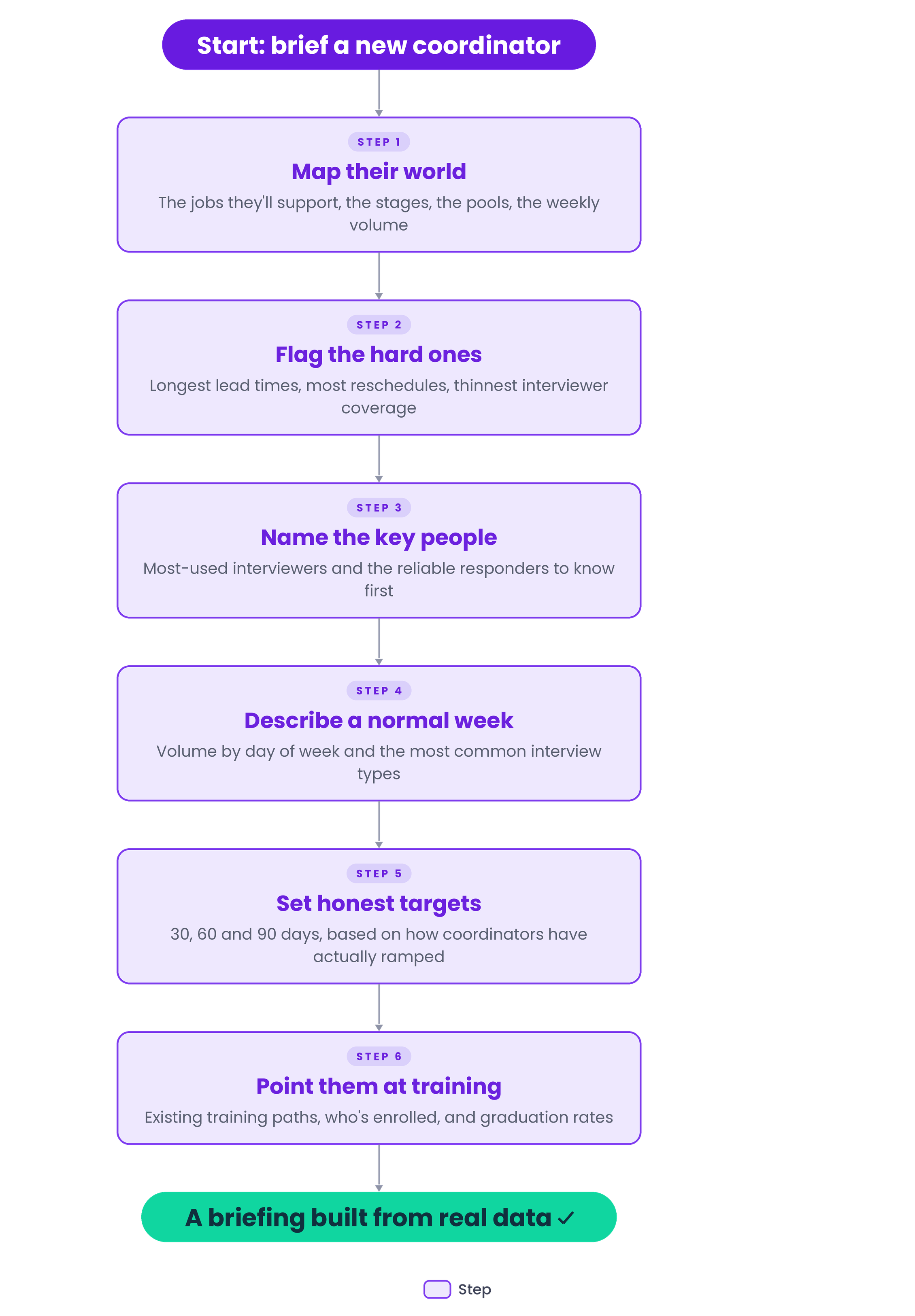
New people join without the context your tenured team carries in their heads. You can hand them a briefing built from your actual data instead of a generic onboarding doc. This is also useful when you inherit a region or team you didn't build.
Start here
Give me an orientation briefing for a new recruiting coordinator joining the [department] team: the jobs they'll support, the stages in each process, the interviewer pools involved, and the typical weekly interview volume.
Then go deeper
Which roles in this department are historically hardest to schedule — longest lead times, most reschedules, thinnest interviewer coverage? That's what they should be warned about on day one.
Who are the most frequently used interviewers for these roles, and who are the reliable responders they should get to know first?
What does a normal week look like for this team? Show typical volume by day of week and the most common interview types, so they know what's routine versus unusual.
What are our current benchmarks for this team — median lead time, reschedule rate, NPS? Give me realistic 30, 60, and 90 day targets based on what a new coordinator has historically ramped to.
Show me which interviewer training paths exist, who's enrolled, and the graduation rates. I want to know what training this cohort should be pointed at.
Playbook 13: Leadership wants to know if we can absorb a hiring surge
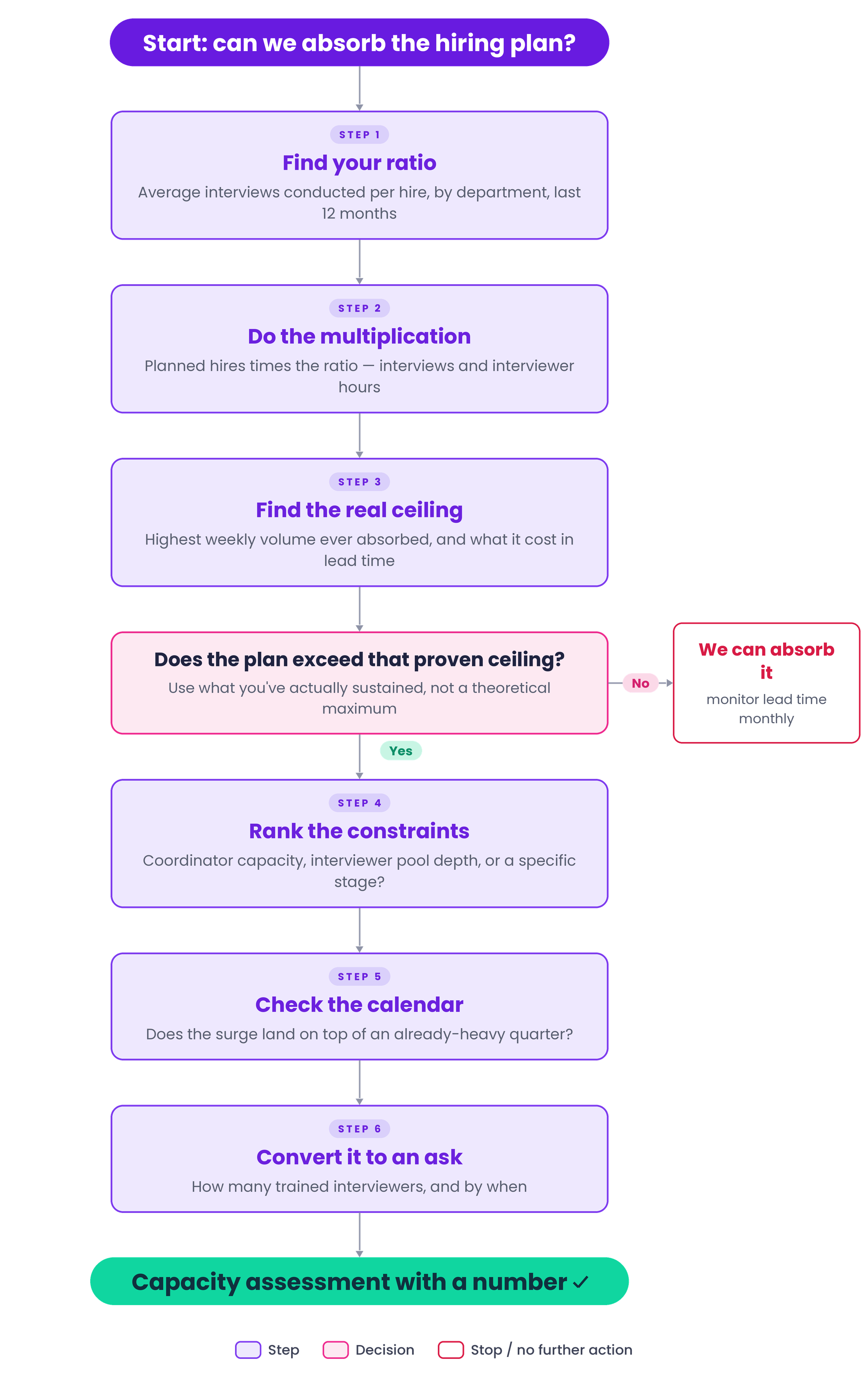
Someone just announced a growth plan and asked whether recruiting can support it. The honest answer needs three numbers: what one hire costs you in interviews, what capacity you have, and where the first thing breaks. Build it from your own historical ratios, not assumptions.
Start here
For each department, calculate the average number of interviews conducted per hire over the last 12 months. Show the full working so I can sanity-check the ratio.
Then go deeper
If we add [number] hires in [department] next quarter, how many additional interviews does that imply based on our historical ratio, and how many additional interviewer hours?
What's the highest weekly interview volume this team has ever successfully absorbed, and what happened to lead time and reschedule rate in that week? That's our realistic ceiling, not a theoretical one.
Given that ceiling, where does the surge break first — coordinator capacity, interviewer pool depth, or a specific stage in the process? Rank the constraints.
Account for seasonality: which quarters are historically our busiest, and does the proposed surge land on top of an already-heavy period?
How many additional trained interviewers would we need to absorb this without lead times rising? Give me a number I can take to the engineering leads as a specific ask.
Summarise this as a one-page capacity assessment: what we can absorb today, what we'd need to absorb the plan, and what happens if we get neither. State the assumptions explicitly.
How to land this
The historical ceiling step is the one that makes this credible. "We've never sustained more than X" is a fact from your own history, not a negotiating position.
The final ask turns a warning into a request. Leaders respond far better to "we need nine more trained interviewers by March" than to "we're at capacity."
A closing note on trust
Every number you plan to act on or share should come with the records behind it. Ask for the underlying rows, spot-check a handful against GoodTime directly, and define your metrics explicitly the first time you use them in a conversation. A dashboard you've validated is worth ten you haven't.
Every prompt on this page is read-only. The connector can't schedule, reschedule, cancel, or modify interviews, and it can't create or edit jobs, stages, interview steps, or applications. It operates entirely within the permissions of the signed-in user.