GoodTime and AI
Last updated: October 12, 2026
Confidentiality Disclaimer:
The content of this Help Article details proprietary technology developed and used by GoodTime.io. This information is intended for GoodTime customers only as a means of providing greater insight in the the technical means by which we employ AI technology into the GoodTime platform so customers can make an informed decision regarding their use of the GoodTime product.
GoodTime invests a great deal of time and effort in maintaining our position as an industry leader in recruiting technology space and we strive to always bring the most recent innovations to our customers to increase the value they receive from our product. Sharing the following data can impact this goal. Dissemination or distribution of this document, in whole or in part, to any third party is strictly prohibited.
The Future of Hiring: GoodTime + AI
At GoodTime, we're committed to delivering innovative solutions that enhance the hiring experience for our customers. As a leader in candidate experience and interview orchestration, we're excited to build Artificial Intelligence (AI) features that drive greater value and efficiency for our customers. To ensure we're harnessing AI's potential responsibly and effectively, we've collaborated with recruiting industry experts to explore AIs future in recruiting.
Through these expert discussions and reflections, we've developed a guiding principle we call "Human-Centric AI." This approach prioritizes the human element in hiring, while automating tasks to maximize efficiency. With human-centric AI, our platform automates routine interview management tasks, engages candidates and interviewers, and provides actionable insights and recommendations. In this help centre article, learn more about our vision for human-centric AI, its benefits, and how this principle drives our technical implementation of AI within the GoodTime platform.
'GoodTime Orchestra' Our Approach: Human Centric AI?
At GoodTime, we believe in harnessing the power of Artificial Intelligence (AI) to augment human capabilities, not replace them. Our human-centric AI approach prioritizes thoughtful, safe, and responsible deployment to amplify team efficiency and effectiveness. By automating quantitative tasks with predictive AI and providing generative decision assistance, our AI enables hiring teams to perform their roles with greater precision and personal touch. We do this through our suite of GoodTime AI features we refer to as 'Orchestra'.
We recognize that AI-driven automation has its limits. While discrete AI algorithms excel in solving quantitative problems, certain recruiting processes require human intuition and empathy. Our platform strikes a balance between automation and human-assisted workflows. Automated tasks streamline administrative functions, freeing humans to focus on high-touch decision-making. This hybrid approach ensures that AI enhances, rather than overrides, human judgment.
GoodTime's philosophy on human-centric AI emphasizes the importance of personal connection in hiring. Our AI is designed to make the hiring experience more human, not less. By retaining a deep respect for the human element, we ensure that efficiency and automation never come at the cost of personality and relationships. With GoodTime's human-centric AI, hiring teams can optimize processes while preserving the essential human touch that defines exceptional hiring processes and candidate experience.
GoodTime AI and our Commitment to Data Security:
GoodTime has already developed and introduced a range of different AI driven features to our platform. While all features adhere to our above philosophy of 'Human-Centric AI', we appreciate that you (and your security teams) may have some additional questions.
Given the varying levels of comfort some companies and industries have with AI, all of GoodTime's AI features have been designed in a way that allow you to decide if wish to use these features, as well as provide you the option to accept or adjust any of the AI recommended results before you act on them.
GoodTime maintains enterprise-grade security and regularly conducts third-party audits. Data security is of the highest standard and your data is always protected in transit and at rest. We are SOC2, GDPR and HIPPA compliant, and we intentionally access the minimum data necessary to conduct the task at hand, while also fully protecting all candidate, interviewer and user data (particularly as it relates to any AI-assisted workflows). Each of GoodTime's AI features operate independently and only collect and process the information you allow it to. Data passed though our AI algorithms contain no PII (Personally Identifiable Information). GoodTime's AI features are not able to access private calendar information and cannot access your emails. GoodTime operates a comprehensive and enterprise-grade information security program designed to protect our user information and maintain strict data security at all times. For more information about our commitment to security, our certifications, and how we handle data please visit our security overview page. To learn more about our specific AI features please review the sections below:
Quantitative/Predictive AI Features:
Core Scheduling Algorithm
Overview:
GoodTime's core scheduling algorithm has always used complex and proprietary algorithmic intelligence to rapidly coordinate interviews by simultaneously considering time zones, interviewer skill sets, availability, load balancing, and preferences, ensuring optimal scheduling across multiple calendars while allowing real-time adjustments from users. The scheduling algorithm also considers previous scheduling outcomes and future scheduled events in order to best recommend interview scheduling options.
Technical Details:
GoodTime uses a meta-heuristic algorithm to support our core scheduling processes to weigh multiple complex conditions and ultimately identify the best time for an interview to occur. Within the 'Schedule Now' workflow the user always has the ability to accept or adjust the recommended results. When using the automated scheduling workflow (that is 'Request Availability' with require review turned off), GoodTime's algorithm will automatically initiate scheduling on your behalf.
Data in use:
The core scheduling algorithm relies upon access to interviewers calendars, candidate provided availability and pre-set interview preferences in order to identify and schedule interviews. Access to interviewer calendars are authorized as part of your initial GoodTime implementation. GoodTime's core scheduling algorithm also relies on calendar data and cloud ids only - the scheduling algorithm does not ingest any PII data allowing us to provide personalized scheduling options whilst maintaining maximum data privacy and security. Finally, customer data is always segregated logically with an account element associated with each data object. This ensures that the scheduling algorithm only ever considers data from your specific organization when offering a scheduling option.
Bottleneck Detection
Overview: GoodTime's core algorithm uses AI to identify inefficiencies and bottlenecks in order to suggest opportunities for optimization within your defined workflows.
Technical Details: Our algorithm proactively analyzes millions of data points present in your hiring workflows as presented by your interviewer calendars, and your scheduling templates and company settings. Any identified inefficiencies or bottlenecks are flagged in-app to the scheduler by way of a warning banner to prompt them to adjust their workflows. As bottlenecks are identified and addressed, GoodTime's algorithm learns from these adjustments, refining its detection ability to become more precise over time
Data in use:
Bottleneck detection processes rely on quantitative scheduling data-points as shared to the GoodTime algorithm via your calendar integration and your user defined scheduling settings. This feature uses GoodTime's proprietary AI to collect and weigh different data points in order to present optimal scheduling solutions whilst also flagging bottlenecks that could impact the ability to schedule successfully. GoodTime's bottleneck detection algorithms only ever ingest information unique to individual customers and refined decision making is unique to each customer (there is no shared data model in use for bottleneck detection). No PII data is required for any of the bottleneck detection process.
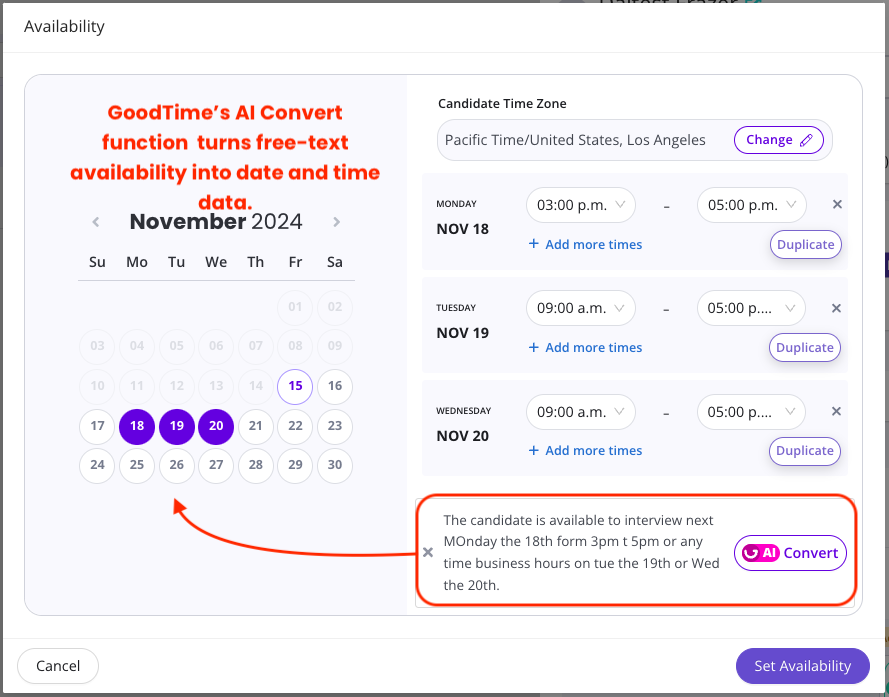
AI Availability Convert
Overview: The AI Convert function in GoodTime 'Set Availability' feature is a discreet AI algorithm designed to streamline the menial task of manually adding the dates and times that a candidate is available into the GoodTime system.
Data in use: The AI Convert function in GoodTime 'Set Availability' feature ingests only the data shared with it via the input box and is designed to take free-text information and re-format it to represent the data as discreet dates and times. Any data not relevant to the specified task is ignored by the algorithm. Users also have the ability to manually edit any of the information returned by the AI 'Set Availability' algorithm and are not forced to accept the output it returns.
AI Job Category Filtering
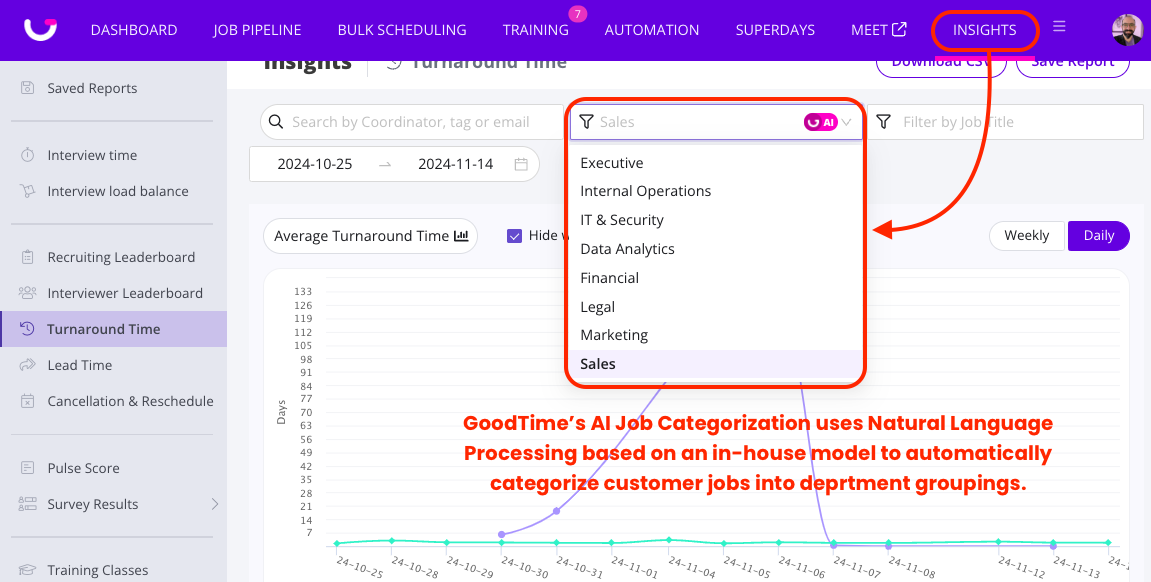
Overview: GoodTime customers can use AI to analyze and categorize their jobs into department groupings. This is done in order to provide customers with the ability to conduct comparative analysis of their own roles against industry benchmarks regardless of the various job title taxonomies and naming conventions in use. This AI driven Job Type Categorization also allows for the customer to quickly review their scheduling data by department without the need to manually categorize roles.
Technical Details: GoodTime uses Natural Language Processing (NLP) based on an in-house model of many interview titles to analyze and categorize jobs into department groupings. In this way we may take an interview title of "Junior Sales Development Rep - Auto Fleet" to correctly categorize it as a "Sales" specific role.
Data in use:
GoodTime uses an in-house data set of job titles and their associated departments in order for our AI algorithm to accurately analyze and categorize a customer's own jobs into department groupings. Individual customer job titles and taxonomies are never shared but are analyzed and categorized on GoodTime's secure servers for the sole purpose of allowing a customer's own jobs to be grouped for quick analysis.
GoodTime Meet - AI Load Balancing
Overview: NOTE: This feature is in GoodTime's 'Meet' product only and not GoodTime 'Hire'.
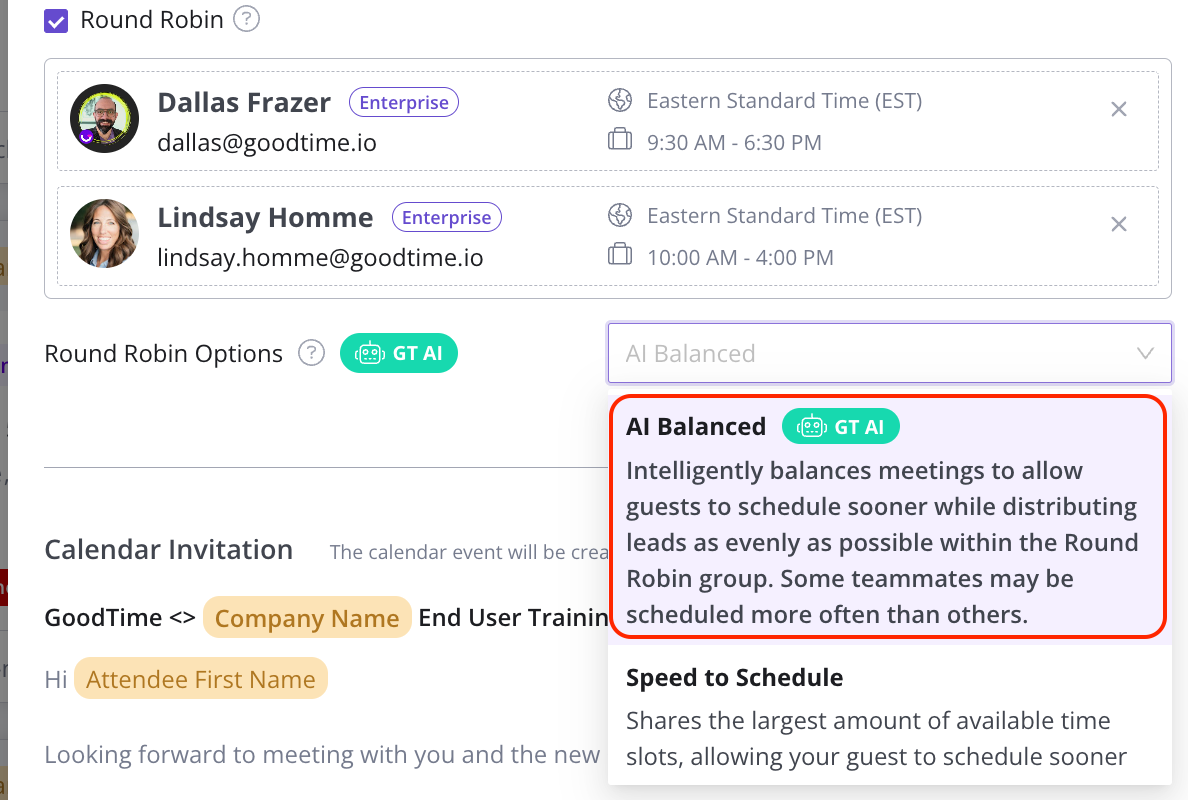
GoodTime Meet utilizes AI to intelligently balance meetings that are scheduled with a 'Round-Robin' group. GoodTime's AI considers all possible meeting times as well as the meeting load of members of the group in order to share maximum availability with the guest so that they can schedule sooner, while also distributing meetings as evenly as possible among the interviewers.
Data in use: This feature relies upon calendar data (approval to access this data is granted by the end user) and internal GoodTime Meet logs that track when named interviewers have previously been scheduled. This discreet AI algorithm relies on these two data points (calendar availability and previous scheduled events) to intelligently strike a balance between sharing maximum availability and equitably sharing the interview load amongst all listed interviewers.
Generative AI Features:
Interviewer Portal
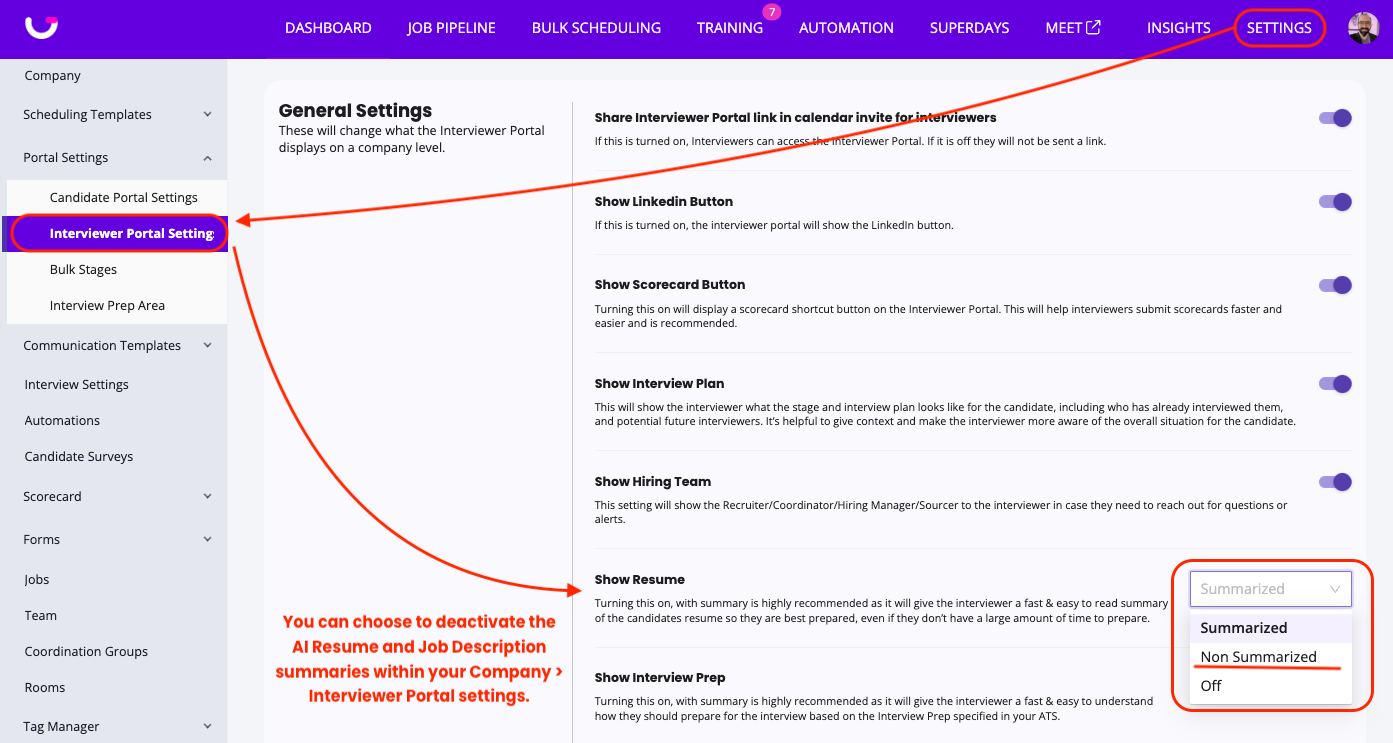
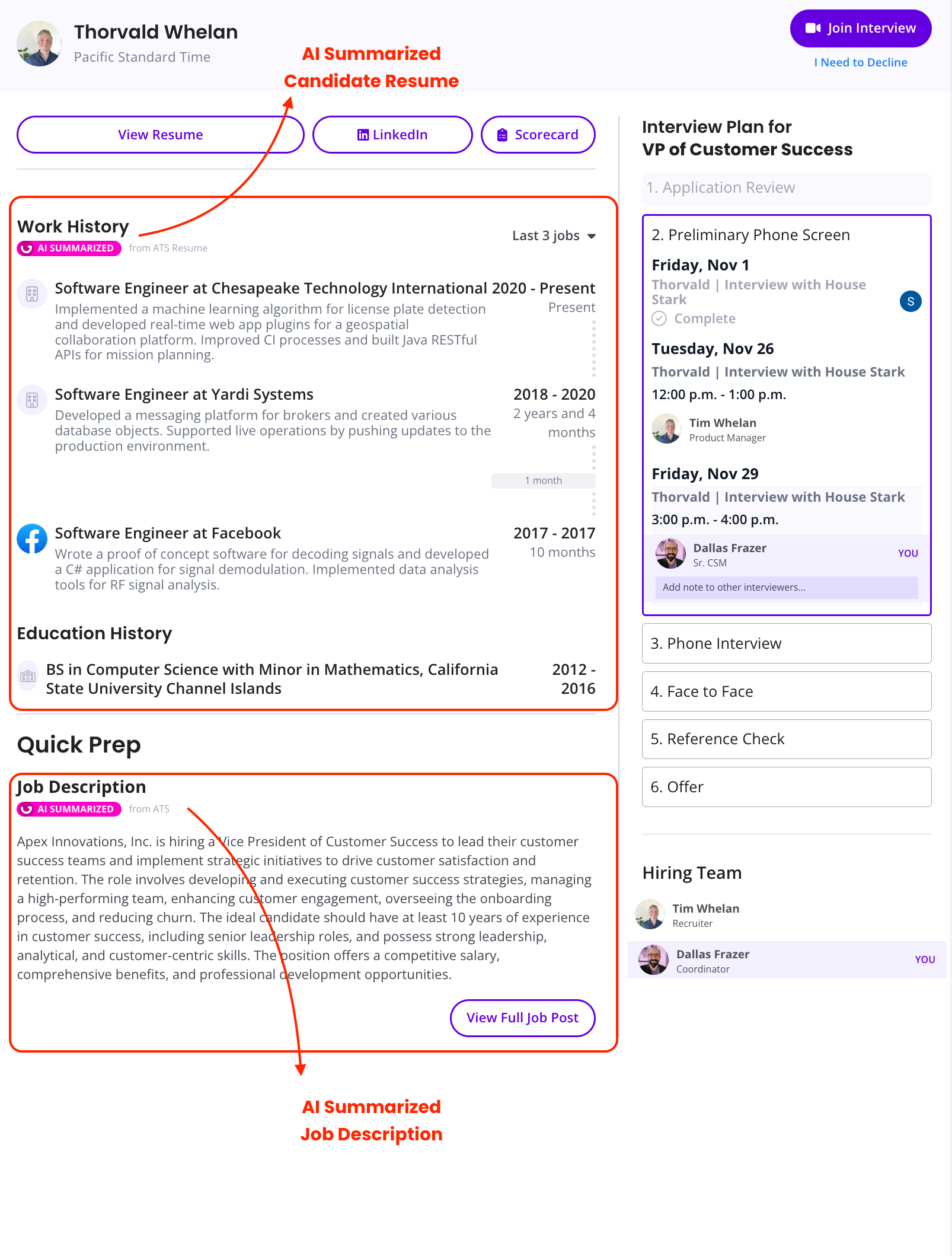
Overview: The GoodTime interviewer portal is designed to streamline an interviewers preparation process prior to conducting an interview by offering summarized versions of key candidate and job role information. GoodTime automatically summarize a candidates Resume, as well as the Job Description of the role a candidate has applied to, in order to assist the interviewer in more easily reviewing and consuming this data prior to hosting an interview. Of note, the GoodTime AI summarization process of a candidates Resume and Job Description is not mandatory and can be deactivated via your company level settings if you do not wish for this feature to be used.
Technical Details:
GoodTime’s algorithm supporting the Interviewer Portal does not make any decisions but only summarizes the data provided. GoodTime locally removes any standard PII from the data submitted within the candidate's resume on our own secure servers before sharing a PII stripped version of the candidate resume to the third party AI engine for summarization. GoodTime does not use a candidate's resume data for any other purpose beyond delivering the defined solution of a summarized version on the Interviewer Portal. Details of all third party processors in use by GoodTime can be seen here: GoodTime's Third Party Processors.
Data in use:
In order to provide the AI summarized Resume and Job Description on the Interviewer Portal GoodTime utilizes the candidate provided resume and company provided Job Description. GoodTime is provided access to both of these elements as part of your initial GoodTime integration, specifically via GoodTime's integration with your Applicant Tracking System (ATS). All standard PII is stripped from these sources before being processed by our AI engine for summarization. Customer data is always segregated logically with an account element associated with each data object. This ensures that any data relevant to your organization is only used for the purposes of providing a service back to your own organization.
Scorecard Polish
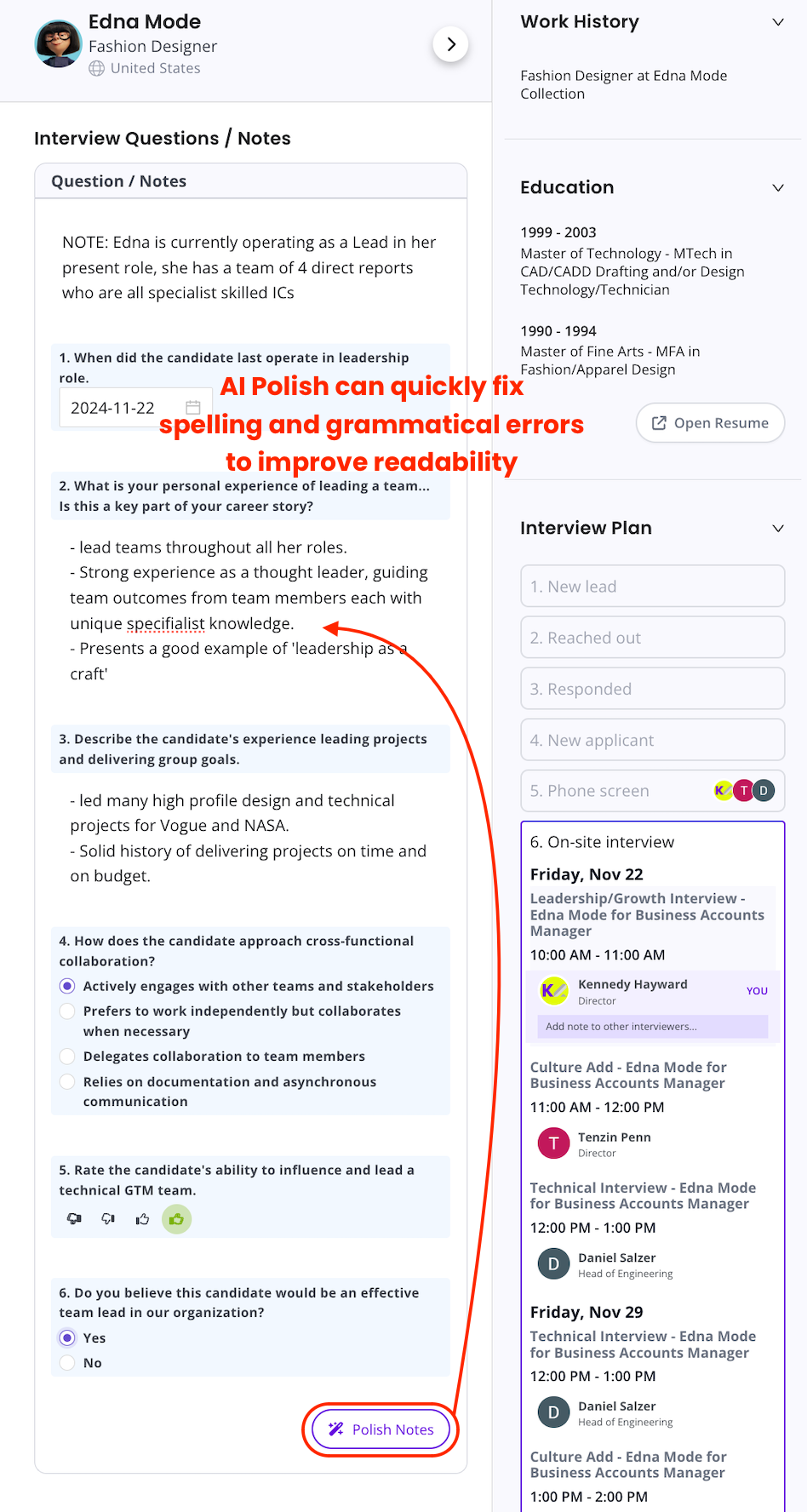
Overview: The GoodTime AI Polish feature is designed to decrease the time it takes for an interviewer to submit their feedback on a candidate post interview. We know from our customer research that many interviewers take separate notes as part of an interview and then scheduled time to later review and 'tidy' these notes before submitting them to the Applicant Tracking System. By providing an automated way to 'polish' interview notes GoodTime aims to eliminate the need for interviews to conduct a separate 'tidy' process and to therefore shorten the feedback submission process.
Technical Details:
The AI Polish feature relies only upon the data provided by the interviewer as part of the scorecard process. The AI Polish algorithm is designed to focus on correcting grammar and spelling mistakes present and to not generate any additional content. The AI Polish algorithm will not alter and information that is correctly spelled or outlined logically. Any output from the AI Polish feature can be edited and adjusted by the interviewer before submitting.
Data in use:
The GoodTime AI Polish feature uses a discreet AI algorithm designed to simply correct spelling and grammar issues within the provided data set. We intentionally do not allow our AI algorithm to generate any additional content than that which is provided. Users always have the ability to manually edit any of the information returned by the AI Polish algorithm and are not forced to accept the output it returns. We encourage users to always review the AI Polished version of their feedback before submission to ensure that their own sentiment as the interviewer continues to be accurately reflected. As the AI Polish feature relies only on discreet input from individual interviewers we are confident that the introduction of bias by this AI algorithm is unlikely. Finally, the AI Polish feature is not required and users can always choose if they wish to use it or not.
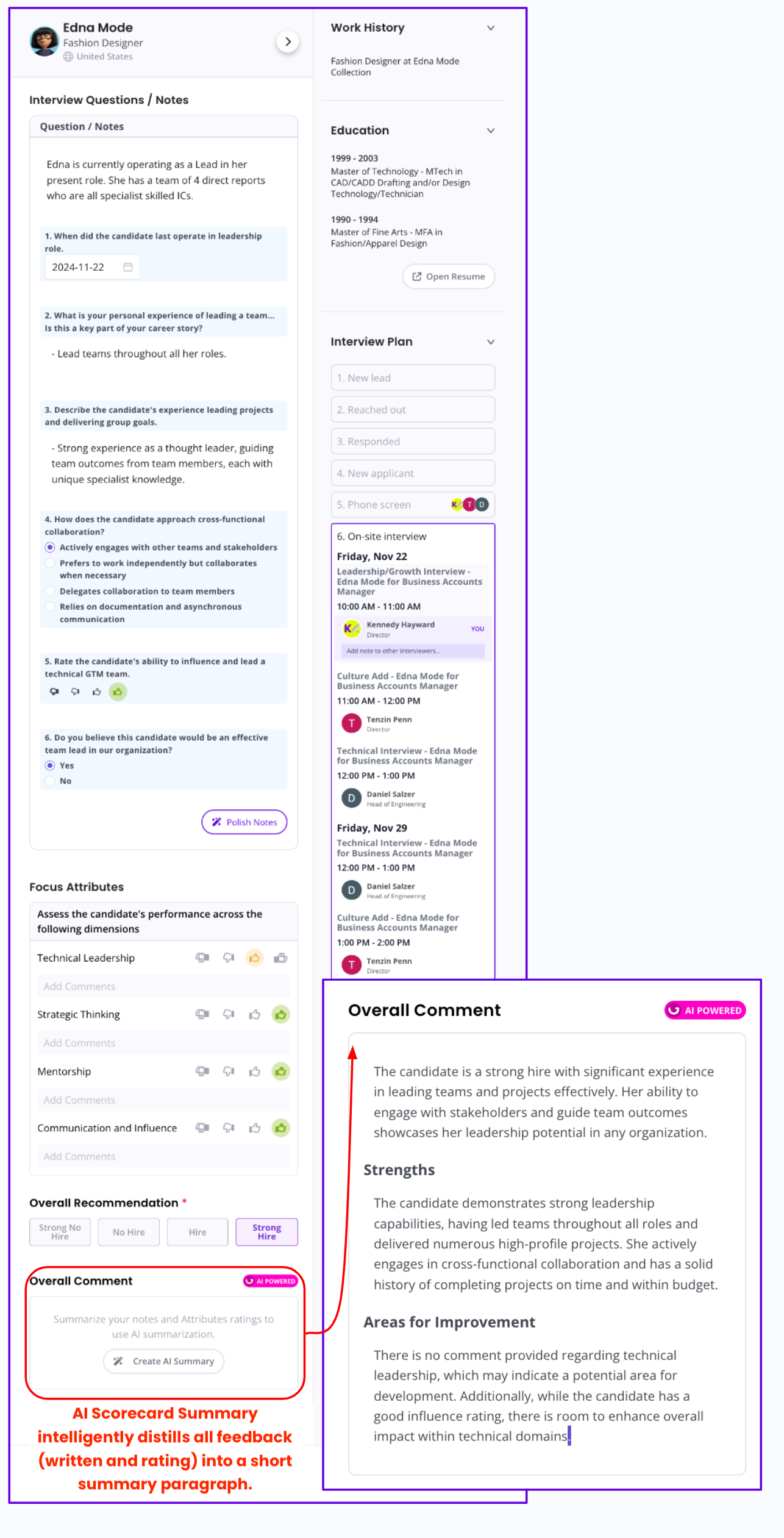
Scorecard Summary
Overview: Reviewing countless scorecards can be cumbersome and time-consuming, often diverting attention away from strategic decision making. GoodTime's AI powered scorecard summaries can streamline how you process interview feedback. By condensing critical insights into manageable, actionable summaries, this feature not only streamlines the decision-making process but enhances the recruitment experience for all parties involved.
Technical Details: GoodTime's Scorecard Summary feature helps to streamline your decision making by intelligently extracting and presenting key sentiments and insights from your interviewers feedback into a shortened summary version. To conduct this summarization, GoodTime draws only from the information directly provided by your interviewers as part of the scorecard completion process and then intelligently analyzes not only their free-text but also any rating-scale feedback to provide a condensed, quickly digestible, version of their feedback.
Data in use: For the GoodTime Scorecard Summary to operate we utilize a LLM (Large Language Model) provided by OpenAI in order to deliver a summarized version of each interviewer's feedback. We are intentional in not allowing our AI model to generate any additional content than that which is provided, but to only contextualize and summarize the data already presented by the individual interviewer. Users always have the ability to manually edit any of the information returned by the AI Scorecard Summary algorithm and are not forced to accept the output it returns. We encourage users to always review the summarized versions of their feedback before submission to ensure that their own sentiment as the interviewer continues to be accurately reflected in the AI Summarized version of their feedback. As the AI scorecard summary feature only relies on discreet input from individual interviewers we are confident that no bias from external sources can be pulled into the summaries presented.